
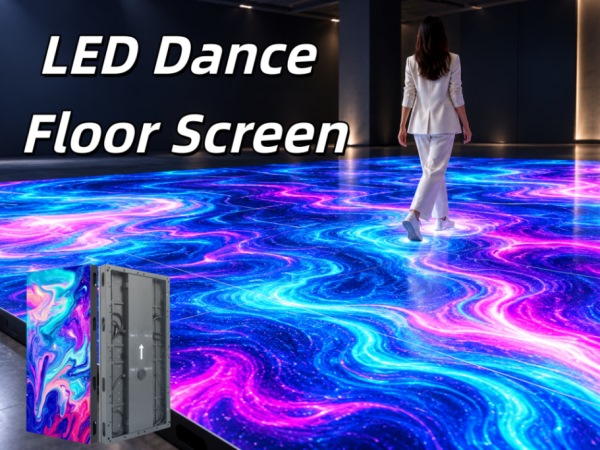
LED floor displays are becoming an important part of immersive events, stage performances, exhibitions, commercial spaces, and interactive installations. However, floor-mounted LED screens face different requirements from conventional wall displays because people and equipment may move directly across their surfaces. For this reason, load-bearing capacity, surface protection, and cabinet strength are essential factors when selecting a floor LED solution. A high load-bearing LED floor is designed to provide both visual impact and structural reliability, making it suitable for environments where frequent foot traffic and substantial weight are expected.
Why Load-Bearing Capacity Matters for LED Floor Displays
Unlike traditional LED screens, floor displays need to withstand direct physical pressure during everyday operation. Performers may walk or dance across the surface, while event equipment, stage structures, or temporary installations can create additional loads. Therefore, a reinforced cabinet is important for protecting the internal LED modules while maintaining a stable display surface. With a load-bearing capacity of up to 3 tons, this LED floor screen is designed to provide a stronger foundation for demanding interactive applications.
30,000 N Load Test Demonstrates Structural Strength
A reliable load-bearing specification should be supported by practical testing rather than simply being presented as a theoretical figure. This product achieves a 30,000 N load test result, equivalent to approximately 3,059 kg, demonstrating its ability to withstand substantial pressure under controlled testing conditions. Consequently, project planners can better understand the structural performance of the screen when evaluating it for demanding environments. The reinforced iron cabinet provides the foundation for this load capacity while helping protect the display modules beneath the surface.
Reinforced Iron Cabinet for Demanding Applications
The cabinet structure plays an important role in determining how a floor LED display performs under pressure. A reinforced iron cabinet provides greater structural support than a lightweight display enclosure, helping distribute external loads across the screen surface. Furthermore, this design allows the display to be considered for both temporary events and permanent immersive installations. Instead of focusing only on visual performance, the cabinet construction addresses the physical demands that naturally come with floor-level installation.
Key Structural Advantages
- Up to 3-ton load capacity: The reinforced iron cabinet supports substantial external pressure for demanding floor applications.
- 30,000 N load test: The tested load corresponds to approximately 3,059 kg, providing a clear reference for structural performance.
- Protective surface: A wear-resistant and anti-slip surface is designed for frequent foot traffic and helps improve user interaction.
- Optional sensing: Module-integrated sensing can be equipped with eight sensing chips per 250 × 250 mm module for interactive applications.
Wear-Resistant and Anti-Slip Surface for Frequent Foot Traffic
Structural strength is only one part of a practical floor display. Since users may walk directly across the screen, the external surface also needs to withstand repeated contact while providing a safer walking experience. The wear-resistant and anti-slip protective surface is designed specifically for frequent foot traffic, helping the display maintain its functionality during repeated use. Moreover, this surface design makes the screen more suitable for interactive stages, exhibitions, commercial events, and other environments where audiences and performers may come close to or directly interact with the display.
Optional Sensing Creates More Interactive Experiences
For projects that require audience participation or motion-based interaction, the display can also support optional module-integrated sensing. Each 250 × 250 mm module can be configured with eight sensing chips, providing a foundation for interactive floor applications. As a result, the LED floor can go beyond simply showing videos or graphics and become part of an immersive experience. This capability can be particularly useful for performances, themed exhibitions, interactive installations, and entertainment venues where movement across the display contributes to the overall visual effect.

Flexible Indoor and Outdoor Installation
Different projects require different installation environments, so flexibility is another important consideration. The product supports indoor and outdoor configurations according to specific project requirements, allowing it to adapt to a wider range of applications. For example, indoor installations can be used for stages, exhibitions, entertainment venues, and immersive spaces, while outdoor configurations can support temporary events and other open-air installations. Therefore, the high load-bearing LED floor can be considered for projects that require both visual presentation and physical durability.
| Application | Performance Requirement | Suitable Product Feature |
|---|---|---|
| Stage performances | Frequent performer movement | 3-ton load-bearing capacity and anti-slip surface |
| Interactive exhibitions | Visitor interaction | Optional module-integrated sensing |
| Temporary events | Easy adaptation to project conditions | Flexible indoor and outdoor configurations |
| Immersive installations | Continuous foot traffic | Wear-resistant protective surface |
| Commercial entertainment | Physical durability and visual impact | Reinforced iron cabinet and LED display |
Designed for Temporary Events and Permanent Installations
A floor LED screen needs to perform reliably whether it is used for a short-term event or a long-term installation. The reinforced cabinet and protective surface provide a structural foundation for both types of projects, while the available configurations allow the display to match different environmental requirements. In addition, the combination of high load capacity and interactive sensing creates opportunities for more creative applications. XINTAI can therefore provide a floor display platform suitable for projects that combine immersive visual content with demanding physical conditions.
Combining Structural Reliability With Immersive Visual Design
The value of a floor LED display is not limited to its ability to produce bright and dynamic visuals. Its physical construction determines whether those visuals can be used confidently in environments where people interact directly with the screen. By combining a reinforced iron cabinet, 30,000 N load testing, a wear-resistant anti-slip surface, and optional sensing technology, this high load-bearing LED floor addresses both structural and interactive requirements.
Ultimately, a successful floor LED project needs to balance visual performance, physical strength, safety-oriented surface design, and installation flexibility. A 3-ton load-bearing design gives project planners a clearer basis for selecting a display for stages, events, exhibitions, and immersive spaces. At the same time, optional sensing technology can transform the floor from a simple display surface into an interactive part of the overall environment. For demanding installations where people and technology need to work together, this combination provides a practical foundation for creating more engaging LED floor experiences.